
How Screen Time Affects Your Eyes and What You Can Do About It

When you stare at a screen for hours, a few things start to go wrong. Your eyes were not built for this kind of nonstop close-up work.
You blink a lot less when staring at a screen. Instead of 15 times a minute, it can drop to just a few. Fewer blinks mean your tears dry up faster, leaving that gritty, burning feeling.
Your eye muscles lock into one position to keep the screen in focus. After hours like that, they get stiff and sore. That’s the dull ache you feel behind your eyes.
Screen text is actually a bunch of fuzzy little dots. Your eyes keep refocusing to make sense of it, and that tiny effort adds up. Your neck and shoulders often tense up right along with them.
Glare and low contrast make things harder to see. Light bouncing off your screen from a window or overhead light forces your eyes to fight past the reflection. When the contrast between text and background is low, your eyes strain even more.
Blue light can mess with your sleep. Evening screen time slows the production of melatonin, the hormone that helps you sleep. Poor sleep leaves your eyes feeling tired the next day.
What You Can Do About It
None of this is permanent. Simple changes can make a real difference.
Try the 20-20-20 rule. Every 20 minutes, find something about 20 feet away. Look at it for 20 seconds. It gives your eye muscles a quick chance to relax. It’s such a small thing, but it really helps.
Blink fully and often. Remind yourself to blink completely while working. A full blink spreads tears across your whole eye, not just part of it. Some people stick a note on their monitor that just says “BLINK.”
Use artificial tears. Keep a bottle of preservative-free lubricating drops on your desk. A drop or two brings back moisture when your eyes feel scratchy.
Fix your screen setup. Sit an arm’s length away. Keep the top of the screen just below eye level so you look slightly down. This position reduces strain on your eyes and neck. Match the screen brightness to the room. If the screen is much brighter, your eyes work harder.
Cut the glare. Close curtains or blinds if a window is behind you. Use lower-wattage bulbs. A matte screen filter can also help.
Take real breaks. Step away from all screens, including your phone. Every couple of hours, get up for 15 minutes. Go outside if you can. Natural light and distance viewing give your eyes a reset.
Do your contacts feel dry and scratchy after hours on a screen? Try wearing glasses instead. Your eyes may feel much better.
A yearly eye exam is a smart habit. It spots issues early. And if your eyes still bother you after trying all these tips, go see a specialist sooner. Some things need a closer look.
For more on how screen time affects your eyes, visit Drs. Roush and Will Optometrists. Our offices are in Albion, Kendallville, and Ligonier, Indiana. Call (260) 636-7788, (260) 347-3458, or (260) 894-3909 to book an appointment today.
https://www.aao.org/eye-health/tips-prevention/digital-devices-your-eyes
https://my.clevelandclinic.org/health/diseases/24802-computer-vision-syndrome
Albion Office
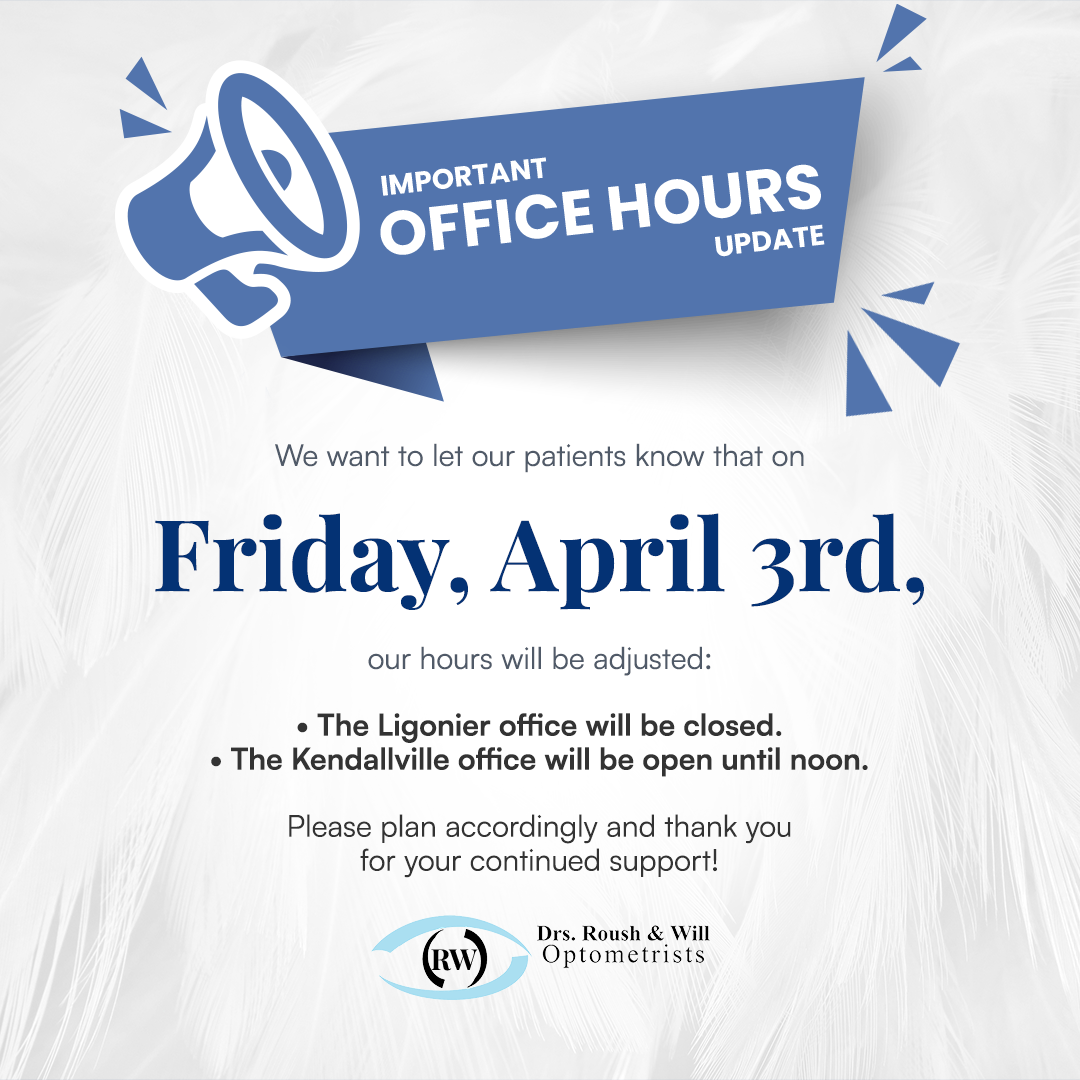
- Monday: Closed
- Tuesday: 8:00 am – 5:30 pm
- Wednesday: 8:00 am – 5:00 pm
- Thursday: 8:00 am – 5:00 pm
- Friday: Closed
- Saturday: By Appointment Only
- Sunday: Closed
- *Closed for lunch 12:00pm - 1:00pm
Kendallville Office
- Monday: 8:00 am – 6:00 pm
- Tuesday: 8:00 am – 5:00 pm
- Wednesday: Closed
- Thursday: 8:00 am – 6:00 pm
- Friday: 8:00 am – 4:00 pm
- Saturday: By Appointment Only
- Sunday: Closed
- *Closed for lunch 12:00pm - 1:00pm
Ligonier Office
- Monday: 8:00 am – 5:00 pm
- Tuesday: Closed
- Wednesday: 8:00 am – 6:00 pm
- Thursday: Closed
- Friday: 8:00 am – 4:00 pm
- Saturday: By Appointment Only
- Sunday: Closed
- *Closed for lunch 12:00pm - 1:00pm
© 2026 Drs. Roush and Will Optometrists. All rights Reserved. Accessibility Statement - Privacy Policy - Sitemap
Powered by: